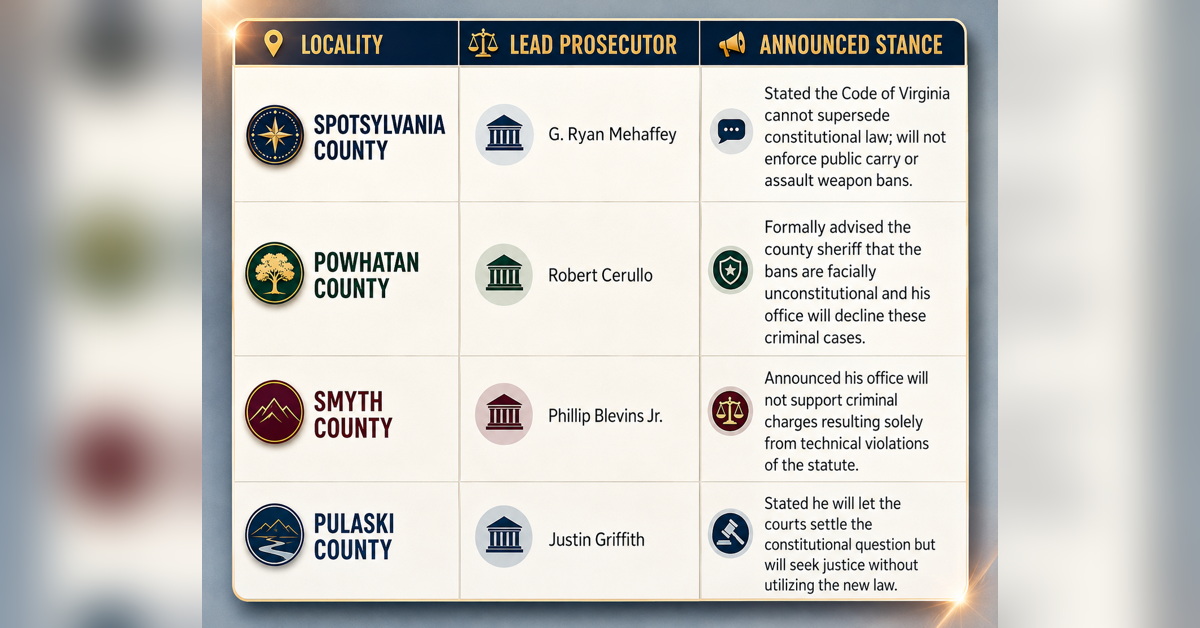
Four Virginia County Prosecutors Reject Assault Weapons Law Enforcement
Four Virginia county prosecutors formally announced they will not prosecute violations of the state's assault weapons ban before it takes effect January 1, 2021. This represents an open refusal to enforce state law based on constitutional grounds.
The prosecutors cite Second Amendment protections as their legal foundation. They argue the statute cannot withstand constitutional scrutiny and declined to use their offices to prosecute citizens under the new restrictions.
Constitutional Basis for Non-Enforcement
The prosecutors' stance centers on Second Amendment interpretation. They view the assault weapons ban as unconstitutional and refuse to criminally prosecute law-abiding gun owners for possessing firearms that fall under the statute's definition.
This action exposes a critical vulnerability in any firearm restriction: prosecution requires willing participants throughout the criminal justice system. Prosecutors hold discretionary power over charging decisions. When multiple county prosecutors refuse simultaneously, enforcement becomes functionally impossible across their jurisdictions.
Why This Matters for Gun Owners
The Virginia prosecutors' refusal demonstrates that laws on the books don't automatically translate to enforcement. Even after legislation passes and takes effect, implementation depends on cooperation from law enforcement and prosecutorial officials who swear an oath to the Constitution.
Gun owners in those Virginia counties benefit from de facto protection through prosecutorial non-enforcement. This creates a practical distinction between what the statute says and what will actually result in criminal charges.
The action also signals broader concerns within the criminal justice system about constitutional validity. When multiple prosecutors in the same state refuse enforcement simultaneously, they're collectively asserting that the law conflicts with constitutional protections they're sworn to uphold.
The Enforcement Problem
State legislatures can pass restrictions, but those restrictions require willing enforcement. Police can decline to arrest. Prosecutors can decline to charge. Judges can rule against constitutionality. Juries can refuse to convict.
The Virginia situation highlights this enforcement chain. Without prosecutors willing to take cases to trial, the assault weapons ban becomes symbolic rather than functional in those counties.
This creates legal uncertainty. Gun owners still technically possess firearms that violate state law, even though prosecution appears unlikely in those jurisdictions. The constitutional challenge remains unresolved in court, and the statute remains on the books despite prosecutorial refusal to enforce it.
DownRange Analysis
The Virginia prosecutors' action reflects genuine constitutional concerns circulating through law enforcement. These aren't rogue officials—they're county prosecutors making a principled stand about what they believe violates the Second Amendment.
For gun owners, this illustrates that ownership rights aren't determined solely by legislative action. They're also determined by whether officials throughout the system will actually enforce restrictions. A law without enforcement is merely a statement of intent.
The move also suggests that when multiple officials in the same state reach the same conclusion about unconstitutionality, courts may take those assessments seriously in future litigation. Prosecutors don't typically refuse enforcement lightly.
What remains unresolved is whether Virginia will pursue the matter through state courts or allow non-enforcement to continue. The prosecutors have placed the ball in the legislature's court and forced a choice: pursue charges despite prosecutorial resistance, or acknowledge the constitutional concerns their own officials have raised.
For now, gun owners in those Virginia counties have practical protection through prosecutorial discretion—an important reminder that constitutional rights depend on both written law and willing enforcement throughout the system.